What to Expect From a Professional Turbine and Compressor Repair
You Know Something’s Wrong. Here’s What Happens When You Bring It In.
When a turbine or compressor goes down, you’re not just looking at a repair bill. You’re looking at production loss, scrambled maintenance schedules, and the pressure to get back online as fast as possible without cutting corners that come back to bite you later.
The shops that earn repeat business from industrial facilities are the ones that take the time to do it right — complete teardown, thorough inspection, honest assessment, and documentation that tells you exactly what was done and why. No mystery. No surprises.
Here’s what a professional turbine and compressor repair looks like from start to finish.
Why Turbines and Compressors Fail
Before a competent shop touches a wrench, they want to understand why the machine failed. Fixing the damage without addressing the cause is a short-term repair that ends up back on your floor in another cycle.
The most common failure modes in turbines and compressors share a few root causes:
Bearing failure is the most frequent culprit. Bearings take the brunt of shaft loads, and when lubrication breaks down — whether from contaminated oil, inadequate supply, or oil that’s degraded past its service life — bearing surfaces wear and eventually fail. A bearing failure that goes undetected long enough will damage the shaft, housing, and anything else in the path.
Seal degradation allows process gas or steam to migrate where it shouldn’t, reducing efficiency and eventually causing contamination or secondary damage. In compressors handling corrosive gases, a seal failure that lets the process fluid reach bearing or shaft surfaces accelerates damage quickly.
Rotor imbalance and misalignment generate vibration that fatigues components over time. What starts as a detectable but tolerable vibration signature progressively worsens, and the machine that was running rough six months ago is now the machine that tripped on high vibration and took out a bearing in the process.
Corrosion and erosion are common in machines handling steam, wet gas, or abrasive process streams. Blades, impellers, and diaphragms that have been thinned by erosion or pitted by corrosion can crack or shed material under load.
Understanding which failure mode drove the current repair tells the shop what to inspect carefully, what tolerances to hold, and what recommendations to make about operating conditions or maintenance intervals going forward.
The Teardown: What a Complete Disassembly Actually Involves
A complete turbine or compressor repair starts with a complete teardown. Not a partial disassembly to address the obvious damage — everything comes apart so everything can be inspected.
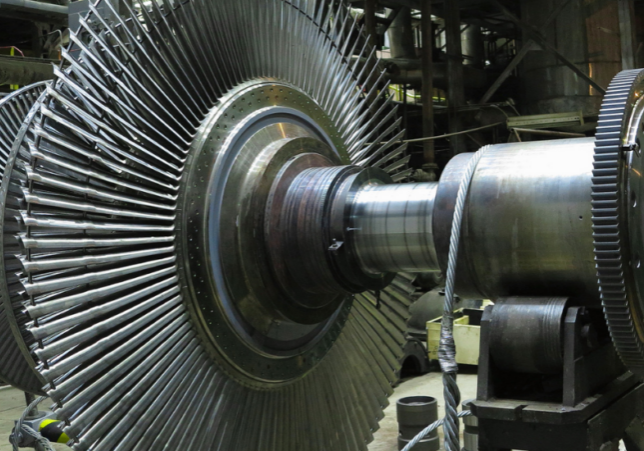
The rotor assembly is pulled and moved to a dedicated area for shaft inspection and balance work. Bearings are pulled and set aside for evaluation — even if they look okay visually, they get measured. Seals, seal rings, and packing are removed. Casings are inspected inside and out. Diaphragms, blade rows, impellers, and diffusers are cleaned and examined.
Everything gets tagged and documented. Serial numbers, measurements before disassembly, photographs of damage, condition notes on each component. This isn’t paperwork for its own sake — it’s the baseline that determines what gets repaired, what gets replaced, and what your finished machine spec looks like when it goes back together.
Shops that skip the full teardown are betting that the damage is limited to what they can see. That’s a bet that loses often enough that experienced maintenance managers don’t take it.
Inspection and Measurement
With the machine fully disassembled, the inspection phase is where the real assessment happens.
Shaft Inspection
The shaft gets a thorough dimensional check — diameter measurements at bearing journals, seal areas, and coupling fits, compared against OEM specifications. Straightness is checked. Surface condition at bearing contact areas is evaluated for scoring, pitting, or wear that would affect bearing fit or performance. Magnetic particle inspection or dye penetrant testing is used to identify cracks that aren’t visible to the eye, particularly in areas that experience stress concentration.
A shaft that looks serviceable but has a crack in a fillet radius is a shaft that needs to be replaced, not returned to service. Finding it during teardown is the job.
Rotor Balancing
A rotor that goes back into a machine out of balance generates vibration that will wear out the new bearings faster than the old ones failed. After inspection and any machining or component replacement, the rotor gets balanced on a dedicated balancing machine. For high-speed machines, this means multiplane dynamic balancing to the tolerances specified by the OEM or applicable standards.
This step is not optional. It’s what separates a repair that runs quietly for years from one that starts vibrating within months.
Casing and Stationary Components
Casing bores are measured and compared to specification. Worn or damaged bore surfaces may require machining and sleeving to restore proper bearing fits. Diaphragms are inspected for cracking, erosion, and distortion. Seal housings are checked for concentricity. Clearances throughout the stationary assembly are documented.
In steam turbines, blade condition is evaluated for erosion from moisture droplets, corrosion pitting, and leading-edge damage. Damaged blades are replaced — not blended down past acceptable limits to avoid replacement.
Machining and Repair Work
What the inspection finds determines what the machine shop does.
Houston Dynamic operates a large-capacity machine shop in-house, which means the work doesn’t go to a subcontractor whose schedule and quality you can’t directly manage. Shaft journals that need to be restored get turned and ground to specification. Worn bores get machined for sleeve installation. Damaged threads get chased or repaired. Components that require fabrication get made to print.
Having machining capability in-house matters most when the inspection turns up something unexpected — a shaft that needs more work than anticipated, a casing bore that requires a repair not covered by a standard procedure. The ability to handle that work without shipping components to another facility is what keeps a repair on schedule when surprises show up.
Replacement parts — bearings, seals, seal rings, coupling components — are sourced to OEM specification or better. On machines where OEM parts are no longer available, components are reverse-engineered and manufactured to the original design intent. This is particularly relevant for older turbines and compressors that have outlasted their OEM support.
Reassembly and Final Inspection
Reassembly is where everything the teardown and inspection found gets validated. Clearances are set and documented at each step. Bearing fits are checked. Seal clearances are measured and recorded. The assembled rotor is checked for runout. Each stage of assembly is inspected before moving to the next.
The assembled machine gets a final dimensional review — shaft end float, coupling alignment, external connections — before it moves to test.
Testing Before It Leaves the Shop
A repaired turbine or compressor that hasn’t been tested before it ships is a machine whose performance has been assumed, not verified.
Mechanical running tests confirm that the assembled machine runs at speed without vibration, noise, or temperature anomalies that would indicate a problem with the repair. For compressors, performance testing verifies that the machine is producing the pressure rise and flow capacity it was designed for. For turbines, testing confirms efficiency and output.
Test data gets documented and travels with the machine. When the equipment goes back into service and your team needs to establish a post-repair baseline for condition monitoring, that test data is the reference point.
What You Should Expect From the Shop
When a turbine or compressor goes to a qualified repair facility, you should come back with documentation that answers every question your maintenance team might ask — what was found, what was done, what was replaced and why, what was measured before and after, and what the machine was doing on the test stand before it shipped.
You should also come back with a machine that runs at the performance and reliability it was designed for. Not a patched version of the machine you sent in.
Houston Dynamic has been repairing turbines, compressors, and rotating equipment for over 50 years from our facility in Houston. We’re an Sundyne repair facility and a Rexnord Authorized Service Center, with the in-house machining and balancing capability to handle repairs without subcontracting the critical work.
If you have a turbine or compressor that needs evaluation — whether it’s actively down or showing signs that a repair is coming — contact us to discuss the work.
Frequently Asked Questions
Houston Dynamic services steam turbines, centrifugal compressors, reciprocating compressors, and associated rotating equipment used in industrial and petrochemical applications. As a Sundyne repair facility, we handle Sundyne pumps and compressors in addition to general rotating equipment. If you’re unsure whether your equipment falls within our service range, contact us and we’ll give you a direct answer.
Timeline depends on the scope of damage found during teardown and inspection, parts availability, and any machining work required. A typical repair involving bearing replacement, rotor balancing, and seal work can be completed in two to four weeks. Repairs requiring shaft work, casing machining, or parts fabrication take longer. We provide a timeline estimate after teardown and inspection, when we know what we’re actually dealing with.
A complete teardown includes full disassembly to component level, documented dimensional inspection of all critical components, non-destructive testing of the rotor and high-stress components, evaluation of bearings, seals, and seal rings, casing bore inspection, and a written assessment of findings and recommended repair scope. Every component that comes out is tagged, measured, and photographed. You receive a complete teardown report before repair work begins.
Yes. For turbines and compressors that have outlasted OEM support or where original parts are no longer in production, we reverse-engineer and manufacture replacement components to the original design specifications. Our in-house machine shop handles this work directly.
Every completed repair includes a teardown and inspection report documenting findings and the repair scope performed, dimensional records for critical clearances and measurements, rotor balance certification, and test data from the mechanical running test. This documentation supports your maintenance records and provides the baseline data your condition monitoring program needs.
Call us. We handle emergency repairs and can work with your team to evaluate the fastest path to getting the machine back in service. Emergency situations require honest assessment of what the repair involves — shortcuts that get a machine running quickly but leave it vulnerable to repeat failure are not in your interest or ours.
A rotor that is even slightly out of balance generates vibration at running speed. In high-speed turbomachinery, small imbalances produce significant vibration forces that fatigue bearings, seals, and shaft components. The repaired machine that starts vibrating within months of going back into service is usually a machine where balancing was skipped or inadequately performed. We balance every rotor as a standard part of the repair process, not as an optional add-on.
Share this post:
Recent posts: