What Causes a Pump Cavitation And How to Stop It
That Rattling Sound Isn’t Random. Here’s What’s Happening Inside Your Pump.
If you’ve been around centrifugal pumps long enough, you’ve heard it: a sound like gravel rolling around inside the casing, sometimes a rattle, sometimes a crackle. What you’re hearing is cavitation — a condition where vapor bubbles form inside the pump and collapse violently against metal surfaces, releasing pressure shockwaves with every cycle.
Left unaddressed, cavitation will pit the impeller, damage the casing, destroy the mechanical seal, and eventually take out the bearings. What starts as an unusual noise becomes a pump-down situation faster than most maintenance teams expect — and the longer it runs, the more expensive the repair.
Here’s what’s happening inside the pump, why it happens, and what to do about it.
What is Cavitation?
Cavitation is a fluid dynamics problem that produces mechanical damage.
When pressure at the pump inlet drops below the vapor pressure of the fluid being pumped, the liquid locally vaporizes and forms small bubbles. Those bubbles are carried into the impeller as the pump pulls fluid through. When they reach a region of higher pressure inside the impeller, they collapse — not gradually, but violently, in microseconds, releasing energy as concentrated pressure shockwaves.
One bubble collapsing does negligible damage. A pump in full cavitation generates thousands of these collapses per second, many of them directly against metal surfaces. The result is the pitted, cratered impeller surface that’s familiar to anyone who has opened a pump that’s been running cavitated. Material is literally blasted away by shockwaves originating within the fluid itself.
That’s why cavitation sounds the way it does. The noise is those collapses.
Top 4 Causes of Cavitation
1. Insufficient Net Positive Suction Head (NPSH)
Every centrifugal pump has a minimum suction pressure requirement — the Net Positive Suction Head Required (NPSHr) — published in the pump’s performance data. If the suction conditions at your installation can’t provide at least that much pressure above vapor pressure (NPSHa — Net Positive Suction Head Available), the fluid is going to flash at the pump inlet.
NPSHa gets squeezed by a lot of things that seem minor in isolation: suction line that’s too long or too small, too many fittings and valves between the tank and the pump, a strainer that’s partially plugged, a tank level that’s dropped lower than the pump was sized for, or a fluid temperature that’s higher than the original design condition. Any one of these eats into the margin between available and required, and when that margin goes to zero, the pump cavitates.
2. Operating Too Far Off the Best Efficiency Point (BEP)
Centrifugal pumps are designed to run efficiently at a specific flow rate — the best efficiency point. When a pump runs significantly to the right of BEP (too much flow) or significantly to the left (too little flow), the hydraulics inside the impeller become turbulent, creating localized low-pressure zones on the blade surfaces where cavitation nucleates even if suction conditions are perfectly adequate.
A pump that was correctly sized for its original application but is now handling a different flow condition — because the system changed, because a bypass was opened or closed, or because the pump is running on a system curve it wasn’t designed for — can cavitate purely from the hydraulic mismatch, with no suction side problem at all.
3. Suction Line Problems
Air entrainment, vortexing, and suction line configuration issues can all produce cavitation-like symptoms or accelerate cavitation damage.
A suction line that’s too small creates excessive velocity and pressure drop before the fluid reaches the pump. A partially open suction valve has the same effect. A poorly designed suction pit or tank without a vortex breaker allows the pump to pull air into the impeller at lower liquid levels, which acts similarly to vapor bubble formation.
Air in the system is particularly deceptive because it mimics cavitation noise and causes similar performance degradation, but the fix is different — it’s an air leak or vortexing issue, not an NPSH problem.
4. Temperature or Fluid Changes
Vapor pressure increases with temperature. A pump that ran without cavitation for years at one operating temperature may start cavitating if the fluid temperature increases — because the same suction conditions that previously provided adequate NPSH margin may no longer be sufficient.
Similarly, a fluid with a higher vapor pressure than the original design fluid — a change in product, a change in concentration, a seasonal process adjustment — can trigger cavitation without any change in the pump or piping system at all.
How to Recognize Cavitation Before It Becomes a Failure
Cavitation that’s caught early is a maintenance adjustment. Cavitation that runs for weeks or months is a pump rebuild.
Sound is the first indicator most people notice — the rattling, crackling, or gravel sound from the pump casing. Not all cavitation is loud enough to hear clearly over plant background noise, but if the pump sounds different than it normally does, it’s worth investigating.
Vibration increases when a pump cavitates. If your facility monitors pump vibration, a trend up from baseline without a corresponding change in operating conditions is a flag. Cavitation-induced vibration has a characteristic broadband frequency signature that distinguishes it from imbalance or misalignment, though diagnosing from vibration data alone requires some experience with what you’re looking at.
Performance degradation — reduced flow, reduced discharge pressure, or a pump that can’t hit its expected operating point — can indicate cavitation in the impeller, particularly if the drop is intermittent or variable.
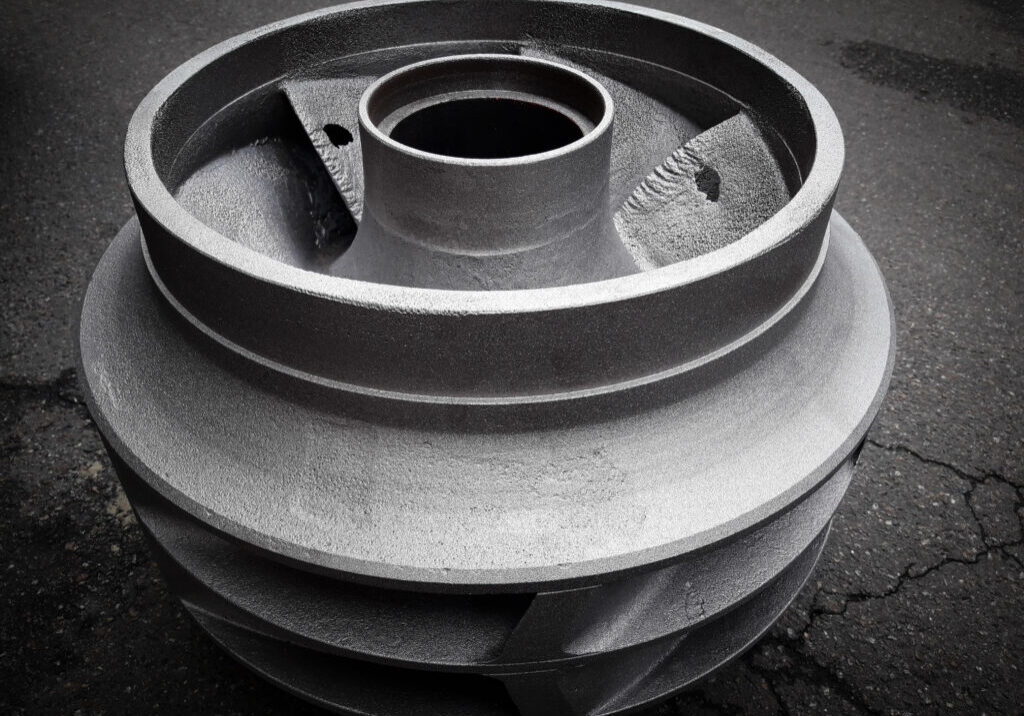
Impeller inspection tells you definitively. An impeller that’s been running cavitated shows characteristic pitting on the low-pressure side of the blades — the leading edge on the suction side, the areas where local pressure drops lowest. If you’re opening a pump for any reason and the impeller shows that damage pattern, cavitation has been occurring regardless of whether it was audible.
Fixing the Immediate Damage
If a pump has been running cavitated long enough to damage the impeller, you’re looking at a repair — not just an operating adjustment.
Cavitation damage to an impeller shows up as pitting, cratering, and material loss that disrupts the hydraulic geometry the pump was designed around. An impeller with significant cavitation damage won’t just look bad — it will perform poorly, and the damaged surfaces are stress concentration points where cracks can initiate under continued cyclic loading.
Impeller replacement is the most straightforward solution for significantly damaged impellers. A new impeller restores the pump to original hydraulic performance and eliminates the damaged surfaces.
Weld repair and re-machining can restore impellers with moderate damage, depending on the material and the location of the damage. Not all materials weld predictably, and not all damage locations are practical to repair — but for large, expensive impellers where replacement lead time is a constraint, repair is worth evaluating.
Protective coatings applied after repair or replacement can extend service life in applications where cavitation is unavoidable. Epoxy-based coatings provide surface hardness that resists pitting better than the base metal in some applications.
The mechanical seal and bearings should be inspected any time a pump is opened for cavitation damage — the vibration from sustained cavitation accelerates wear on both.
Fixing the Root Cause
Repairing the damage without correcting the condition that caused it puts you back in the same place in another operating cycle.
The fix depends on which cause is in play:
If it’s an NPSH problem: Increase the available suction head by raising the liquid level, reducing suction line losses (shorter or larger suction line, fewer fittings, eliminating a partially plugged strainer), or reducing fluid temperature if that’s a variable. In some cases, a pump with lower NPSHr can be substituted for the existing unit.
If it’s an off-BEP operating condition: Evaluate whether the system has changed since the pump was originally sized, and whether the pump selection still matches the actual operating requirements. Sometimes the answer is a different impeller trim or a different pump altogether.
If it’s a suction line configuration issue: Address the vortexing, air entrainment, or high-velocity suction run that’s creating the low-pressure condition.
If it’s a fluid or temperature change: Recalculate NPSHa for the new operating conditions and determine whether the existing pump has adequate margin.
Houston Dynamic can help you work through the root cause analysis alongside the repair. Understanding why the pump failed is part of the job — a repair that doesn’t address the operating condition that caused the damage isn’t a complete repair.
When to Bring It In
If you’re hearing cavitation noise, seeing performance issues, or opening a pump and finding the pitting pattern on the impeller, it’s time to pull the pump and have it evaluated.
Houston Dynamic has been repairing centrifugal and rotating pumps in Houston for over 50 years. We do complete teardown and inspection, impeller repair or replacement, mechanical seal service, balancing, and reassembly — with in-house machining capability to handle whatever the inspection turns up. We also provide emergency pump repair for situations that can’t wait for the next scheduled window.
Frequently Asked Questions
What does cavitation sound like in a pump?
Cavitation typically sounds like gravel or marbles rattling inside the pump casing, or a crackling noise that varies in intensity. The sound comes from vapor bubbles collapsing inside the impeller. Not all cavitation is loud enough to hear clearly over plant background noise. Vibration monitoring and periodic impeller inspection are important supplements to audible detection.
Can a pump run while it’s cavitating?
Yes, but it will continue to sustain damage. A cavitating pump moves fluid at reduced efficiency while progressively damaging the impeller, casing, and mechanical seal. How quickly damage accumulates depends on the severity of the cavitation, but there is no safe level of sustained cavitation. It will degrade the pump over time regardless of how manageable the noise seems in the short term.
How do I know if my pump is cavitating or vibrating from another cause?
The symptom pattern of cavitation is fairly distinctive: intermittent rattling that correlates with operating conditions, accompanied by performance degradation. Vibration from imbalance or misalignment tends to be consistent rather than variable and usually doesn’t produce the crackling sound associated with bubble collapse. Impeller inspection is the most definitive diagnostic. Cavitation damage produces a characteristic pitting pattern on the suction-side blade surfaces that distinguishes it from other failure modes.
What is NPSH and why does it matter for cavitation?
Net Positive Suction Head (NPSH) is the measure of pressure available at the pump suction above the vapor pressure of the fluid. Every centrifugal pump has a minimum NPSH Required (NPSHr). If actual suction conditions can’t provide at least that much pressure margin, the fluid flashes to vapor at the inlet and cavitation occurs. Maintaining adequate NPSH margin is the most direct way to prevent suction-side cavitation.
How much damage can cavitation do to an impeller?
Sustained cavitation can erode impeller blade material to the point of non-function within months in severe cases. The damage is cumulative and self-reinforcing: pitting creates rough surfaces that promote further cavitation nucleation, which accelerates material loss. In severe cases, enough blade material can be lost to put the impeller out of hydraulic balance, generating additional vibration damage to bearings and seals.
Can cavitation damage be repaired or does the impeller need to be replaced?
It depends on the severity and location of the damage. Moderate pitting that hasn’t compromised the blade or significantly disrupted the hydraulic geometry can sometimes be weld-repaired and re-machined. Severe damage, through-wall erosion, or damage in locations that aren’t practical to weld typically requires replacement. We evaluate each case during the inspection phase and make a recommendation based on actual findings.
What’s the fastest way to address cavitation if I’m hearing it right now?
Check the most accessible suction-side variables first: confirm the suction valve is fully open, check for a partially plugged strainer, verify tank level is adequate, and confirm the pump isn’t operating at an extremely low or high flow condition relative to its design point. If none of those correct the problem, the pump should come out for inspection. Running through a known cavitation condition to find a convenient time to address it increases repair scope and cost.
Share this post:
Recent posts: