What Causes Industrial Fan Imbalance, and Why Rebalancing Alone Won’t Fix It

The fan didn’t change. What built up on it did.
An industrial fan starts to vibrate. Someone schedules a rebalance, the readings drop, and the fan goes back into service. Then the vibration returns, and the cycle starts again.
That cycle is rarely random. Repeat imbalance usually means something on the fan wheel has changed, and the vibration will keep returning until that change is found. Houston Dynamic Service (HDS) finds it through teardown and inspection, drawing on more than 30 years of reconditioning, repairing, and rebuilding industrial fans and blowers, including pedestal, lobe, and multi-stage (Hoffman/Lamson) units.
Every repair is backed by in-house dynamic balancing, a full machine shop, and ISO 9001 certification held since 2014. The goal is to correct the source of the imbalance, not only the weight.
How a Small Imbalance Turns Into a Major Industrial Fan Repair
The force created by imbalance grows with the square of rotating speed. As Practical Balancing of Rotating Machinery puts it, “centrifugal (outward) force is proportional to the square of the speed.” Doubling a fan’s speed quadruples the force that the same amount of imbalance places on its bearings.
Bearings carry that force first and wear faster as a result. Seals and couplings absorb the vibration next, followed by the shaft, which can develop fatigue cracks over time.
Left long enough, the damage spreads to welds and hubs on the wheel and to the pedestal, baseplate, and foundation bolts. A correction that once required a few balance weights becomes a job involving new bearings, shaft work, and structural fixes.
CEC Vibration Products describes rotor mass unbalance as “the most common cause of excessive vibration in most rotating equipment and fans.” That makes it the problem most worth catching early.
Top 5 Causes of Imbalance That Fan Balancing Won’t Fix Alone
Each of these causes changes the mass of the wheel after it leaves the shop. That is why a rebalance by itself tends to be temporary when one of them is active.
1. Material Buildup on the Wheel
Process dust, product residue, and moisture collect on blade surfaces, and they rarely collect evenly. As the deposits grow, the mass center of the wheel shifts a little further from its axis of rotation.
2. Erosion and Abrasive Wear
Particulate-laden airflow strikes blade leading edges at high speed and removes metal over time. CEC Vibration Products lists deterioration from “high speed particle collisions” among the causes of rotor unbalance. Erosion is rarely uniform across every blade, so the mass loss is rarely uniform either.
3. Corrosion
Corrosive gas streams and condensing moisture remove material from the wheel, hub, and blade roots. Corrosion also weakens welds and attachment points, which can turn a balance problem into a structural one.
4. Loose, Shifted, or Worn Components
A wheel that has moved on the shaft, a worn key or keyway, or loose set screws and hub bolts all change how mass is distributed during rotation. These conditions can look like imbalance on a vibration reading, but balance weights will not hold loose parts in place.
5. Bent Shaft or Thermal Distortion
According to CEC Vibration Products, high airstream temperatures can cause uneven growth of the fan rotor. Heat cycling, a past rub, or improper storage can also leave a shaft bowed. A bent shaft throws the wheel off its axis, and balance correction cannot permanently remove that offset.
What Is Dynamic Balancing?
Dynamic balancing is the process of correcting a rotor’s mass distribution in two or more planes while it spins, so the rotor runs without generating excess vibration. Imbalance occurs when a rotor’s mass center does not line up with its axis of rotation. Even a small offset produces a force that repeats once every revolution.
Static balancing corrects weight in a single plane and suits narrow rotors. Most industrial fan wheels need correction in two planes because the mass offset can differ from one side of the wheel to the other, creating a rocking motion that a single-plane correction cannot remove.
In a fan, imbalance usually shows up first as rising vibration, and the cause is often mass that has shifted on the wheel. Metrix Vibration describes a power plant induced draft (ID) fan that returned from an outage with elevated vibration. The source was ash that had built up on one quadrant of the impeller. Once the buildup was removed and the rotor was balanced, vibration returned to acceptable operating limits.
How to Tell Imbalance From Other Fan Vibration
Not every vibration problem in a fan is imbalance, and the right fix depends on getting the diagnosis right first.
Vibration at 1x running speed: Imbalance produces a single-frequency vibration once per revolution, with similar amplitude in all radial directions, according to SKF’s guide to spectrum analysis.
High axial vibration: An abnormally high axial reading at running speed, in a system with a coupling or belt, points toward misalignment rather than imbalance.
Long strings of harmonics: Multiple running-speed harmonics at high amplitude generally indicate mechanical looseness.
Bearing defect frequencies: Vibration at frequencies tied to the outer race, inner race, rolling elements, or cage indicates bearing damage.
Wheel inspection: Visible buildup, uneven erosion along leading edges, or cracks at blade roots confirm what the vibration data suggests.
Seeing vibration return after every rebalance? Talk to the HDS team about what is driving it.
How to Fix the Root Cause in Fan and Blower Repair
- Material buildup: Set cleaning intervals based on how quickly deposits return, and clean the full wheel evenly. Where coating loss is part of the pattern, review coating selection during the repair.
- Erosion: Restore eroded leading edges through weld repair, and consider wear-resistant materials on blades exposed to heavy particulate.
- Corrosion: Review wheel and hub materials against the gas stream chemistry. Inspect welds and blade roots with non-destructive testing (NDT) before the fan returns to service.
- Loose or worn components: Restore proper fits, replace worn keys, and torque hub and set-screw connections to specification on reassembly.
- Bent shaft or thermal distortion: Straighten or replace the shaft, then review operating temperatures and startup practices to prevent the same distortion from recurring.
Fixing the Immediate Damage With Industrial Fan Balancing
A lasting repair starts with a complete teardown. HDS begins with disassembly, non-destructive testing (NDT), visual inspection, and dimensional inspection. After the customer approves the quote, the team rebalances, machines, or replaces parts as required to bring the machine back to original factory specifications.
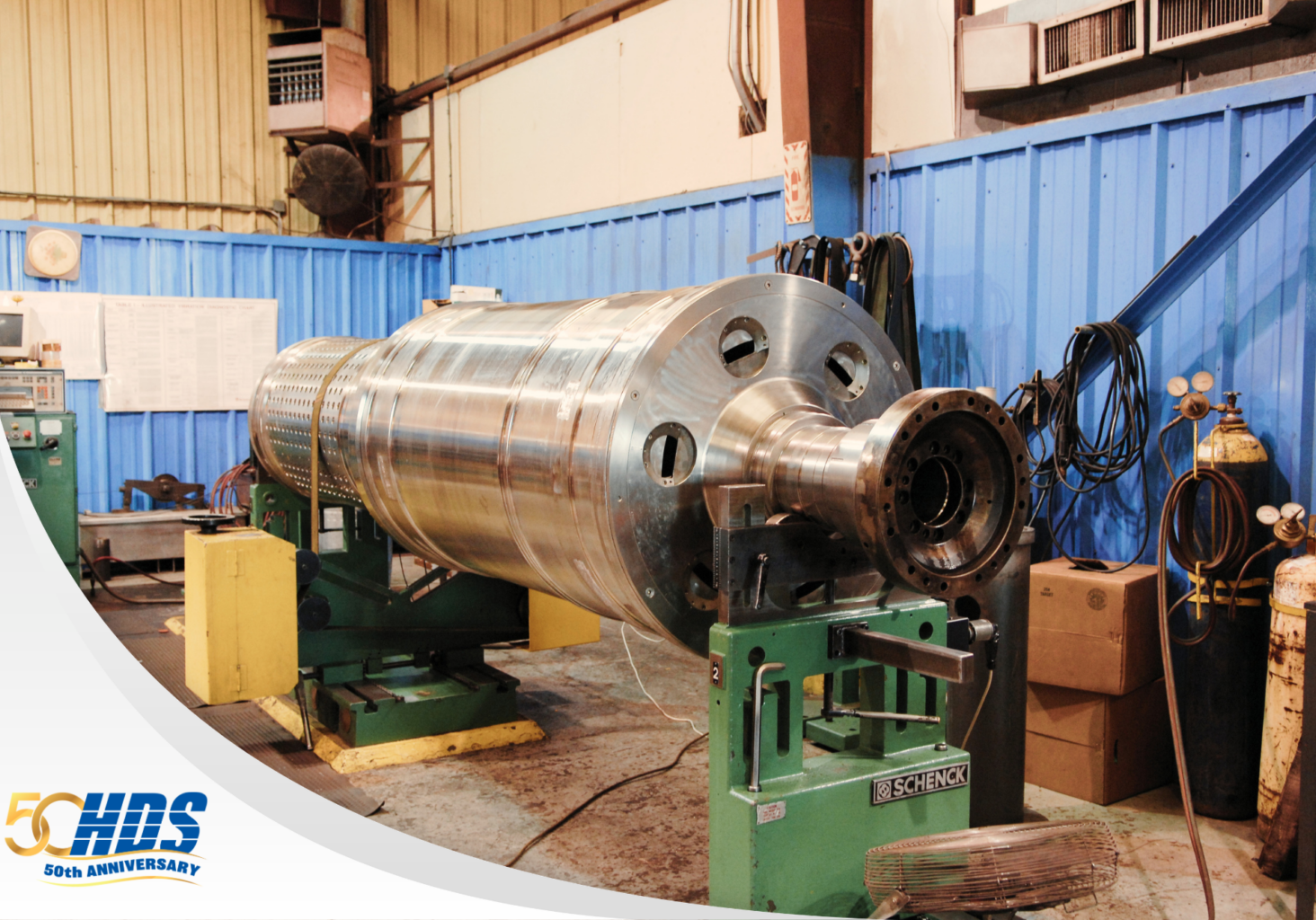
Balancing happens in-house, after final machining. Keeping machining and balancing under the same roof and the same quality system removes the transit time, handling exposure, and quality handoff that come with sending a rotor off-site.
The shop handles turning from small shafts to large rolls, welding and fabrication in carbon steel, stainless steel, and aluminum, and heavy components with a 20-ton overhead crane.
When to Bring Your Industrial Fan In for Repair
A fan should come in for a full evaluation when vibration returns soon after a rebalance, when bearings fail more than once on the same unit, or when inspection shows erosion, cracking, or corrosion on the wheel. Each of those signs means the underlying cause is still active.
HDS is a veteran-owned shop with more than 50 years of rotating equipment repair experience, ISO 9001 certified quality control, and a machine shop built for large components. The goal is a fan that leaves the shop balanced and stays that way.
Frequently Asked Questions About Industrial Fans
Why does my industrial fan keep going out of balance?
Repeat imbalance usually means something on the wheel keeps changing. Material buildup, erosion, corrosion, loose components, and thermal distortion all shift the wheel’s mass after it has been balanced. Rebalancing corrects the symptom, but the vibration returns until the underlying cause is addressed.
Is cleaning the fan wheel enough to fix the imbalance?
Not always. Buildup often breaks away unevenly during cleaning and can take protective coating with it, leaving the wheel lighter in some areas than others. A wheel should be checked for balance after cleaning and inspected for erosion or corrosion hidden under the deposits.
How quickly should industrial fan imbalance be addressed?
As soon as vibration readings show it. The force created by imbalance grows with the square of rotating speed, so even a small offset places a large, repeating load on the bearings. The longer a fan runs out of balance, the further the damage spreads, from bearings to seals, couplings, the shaft, and eventually the wheel and foundation.
How do you know if industrial fan vibration is an imbalance or misalignment?
Imbalance typically appears as vibration at once per revolution, with similar amplitude in all radial directions. Misalignment more often produces abnormally high axial vibration at running speed, especially across a coupling or belt drive. Vibration data narrows the cause, and a teardown inspection confirms it.
What happens during in-house balancing?
In-house balancing means the rotor is balanced in the same facility, and under the same quality system, where it was machined. At HDS, balancing is performed immediately after final machining, which removes the transit time, handling exposure, and quality handoff that come with sending a rotor to an outside shop.
Share this post:
Recent posts: